If you’ve been researching which reverse osmosis faucet is safe and approved for drinking water, here’s a clear answer based on real-world plumbing experience. Short answer: A faucet that is safe for reverse osmosis (RO) water should be lead-free, NSF certified, and specifically approved for RO use in the manufacturer’s specification sheet. Many standard kitchen faucets are not recommended for RO because purified water is more corrosive and can leach metals from non-rated materials. The safest option is a dedicated reverse osmosis faucet or a kitchen faucet that is clearly labeled as reverse osmosis compatible.
I always recommend checking the faucet specifications to confirm RO approval, material construction, and certification details before purchasing or installing one.
Disclosure & Credibility
This article may contain affiliate links that help support the site at no additional cost to you. I only reference products and brands that are commonly used in plumbing supply and real-world residential installations.
This guide is written from a neutral, professional plumbing-supply perspective with the goal of helping homeowners understand what actually matters when choosing a faucet for reverse osmosis drinking water.
If you’re looking for a high-quality faucet that is certified for reverse osmosis water, this Kohler RO-approved drinking water faucet is a great option.
Why a Reverse Osmosis Faucet Needs to Be Approved for Drinking Water
Reverse osmosis water has very low mineral content, which makes it excellent for drinking, coffee, tea, and cooking. However, that same low-mineral water can behave differently when it passes through faucet components and internal metals.
Compared to standard tap water, reverse osmosis water can be slightly more aggressive toward certain materials. Over time, a faucet that is not designed or approved for reverse osmosis use may experience internal corrosion, finish breakdown, or metal leaching into the water pathway — especially in cheaper plated-brass faucet bodies.
This doesn’t mean every regular kitchen faucet will immediately fail when used with reverse osmosis water. But from a long-term safety and reliability standpoint, most plumbing professionals prefer to use a faucet that has been tested, certified, and clearly identified as reverse osmosis approved in the manufacturer’s documentation.
That typically gives you the best combination of water quality confidence, predictable performance, and warranty clarity.
What Makes a Reverse Osmosis Faucet safe and “Approved” for Reverse Osmosis Water
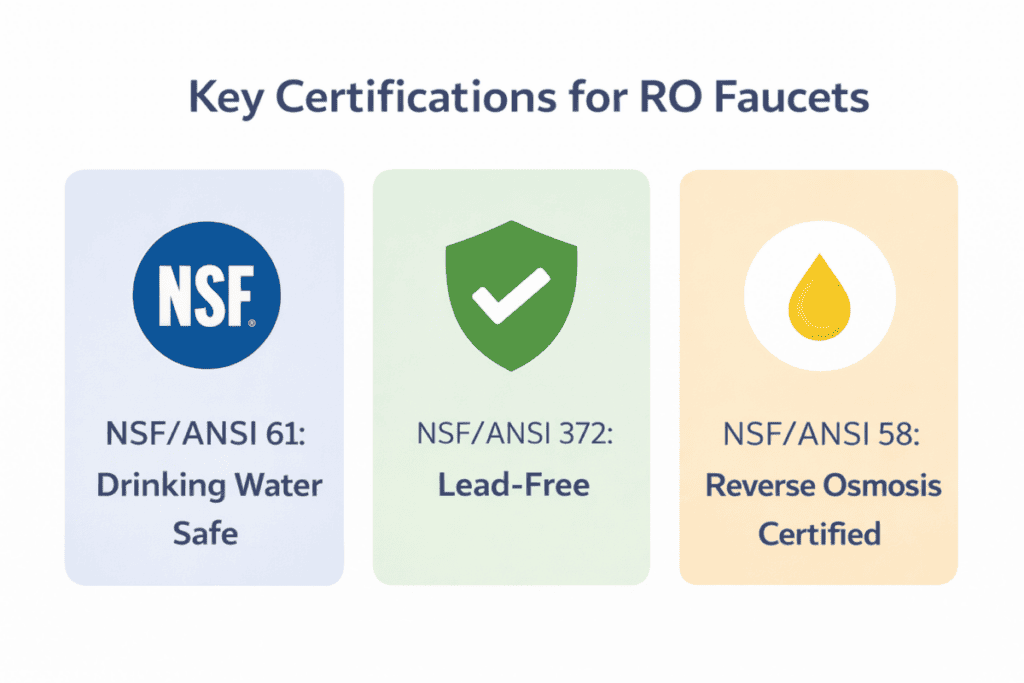
When evaluating whether a faucet is safe to use with reverse osmosis drinking water, the most important information is found in the specification sheet or product documentation. A faucet that is appropriate for reverse osmosis use will generally list:
- certification for drinking water contact (NSF/ANSI 61)
- lead-free compliance (NSF/ANSI 372)
- material details for wetted components
- a statement or note confirming reverse osmosis compatibility
Manufacturers that design faucets for reverse osmosis drinking water almost always document that approval clearly, because it is a selling point and a performance expectation.
If a faucet listing or spec sheet does not mention reverse osmosis at all, I typically advise homeowners to verify compatibility with the manufacturer or choose a faucet that is explicitly RO-approved instead of assuming it will be suitable long-term.
Can a Regular Kitchen Faucet Be Used With Reverse Osmosis Water?
In some situations, a standard kitchen faucet can be used with reverse osmosis water, but it depends entirely on the faucet construction and the manufacturer’s design intent.
A regular faucet is more likely to be acceptable when the internal wetted surfaces are stainless steel, the faucet is fully lead-free certified, and the manufacturer does not restrict the use of reverse osmosis water. Some reverse osmosis systems also allow full-flow faucet connections rather than using a dedicated reverse osmosis faucet.
Even when those conditions are met, there are still a few trade-offs to consider. Reverse osmosis water may increase wear on certain finishes or internal parts over time, and in some cases, connecting to a non-approved faucet may affect warranty coverage from either the faucet manufacturer or the reverse osmosis system manufacturer.
Because of that, many homeowners still choose to use a dedicated reverse osmosis faucet strictly for drinking water, even if a regular faucet could technically be used.
Air-Gap vs Non-Air-Gap Reverse Osmosis Faucets
Reverse osmosis faucets come in two common configurations: air-gap and non-air-gap. Both faucet styles are used in residential installations, and each has a specific purpose.
A non-air-gap reverse osmosis faucet is simpler, quieter, and uses fewer tubes and fittings. It is widely installed and works well when permitted by the reverse osmosis manufacturer and local plumbing code. Many homeowners prefer this style because it has fewer components and tends to be easier to service.
An air-gap reverse osmosis faucet includes additional internal pathways that prevent drain water from flowing back into the reverse osmosis system. In some areas, air-gap faucets are required by code or by local inspection authorities. These faucets are more complex and have more tubing connections, but they exist for backflow prevention purposes in certain plumbing environments.
The best approach is to match the faucet style to your reverse osmosis system and local code requirements. If a system is already using an air-gap faucet, most professionals recommend replacing it with the same style unless the installation manual specifically allows a change.
This keeps the installation compliant, predictable, and aligned with the system design.
Recommended Reverse Osmosis Faucets (Tested, Reliable & RO-Approved)
Choosing a reverse osmosis faucet can feel overwhelming — especially when you’re trying to confirm whether it’s truly RO-approved and made from the right materials. To make things easier, I’ve selected a few reliable options at different price points.
These faucets are widely used in the plumbing industry, have strong customer support, and clearly list RO compatibility in their specifications. Always double-check the product listing or spec sheet for your model of system and local code requirements before purchasing.
Faucet Option #1 — Budget-Friendly RO Faucet
A simple, cost-effective RO-approved faucet that works well for standard residential systems. Good option if you want reliability without paying for premium styling. Best suited for basic kitchens, rentals, secondary sinks, or utility wet bars.
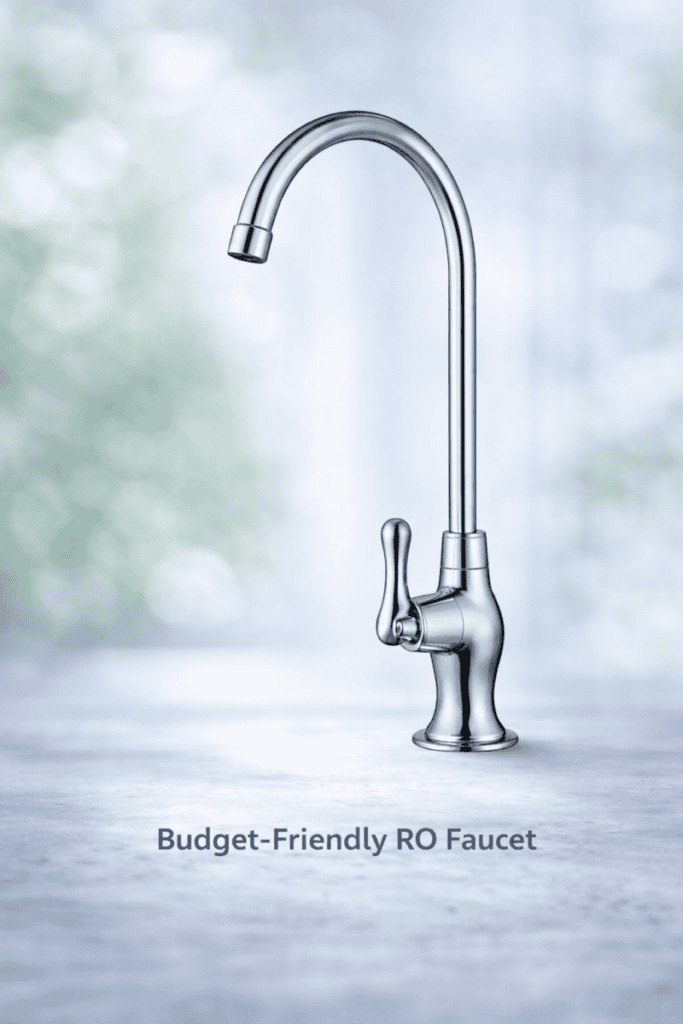
👉 Budget Friendly Reverse Osmosis Faucet
- Material: RO-safe stainless or lead-free brass
- Compatible with most standard RO systems
- Available in multiple finishes
Faucet Option #2 — Mid-Range RO Faucet
A great balance between build quality, aesthetics, and price. This is the style most homeowners choose when upgrading their kitchen faucet to match existing fixtures while still staying RO-approved.
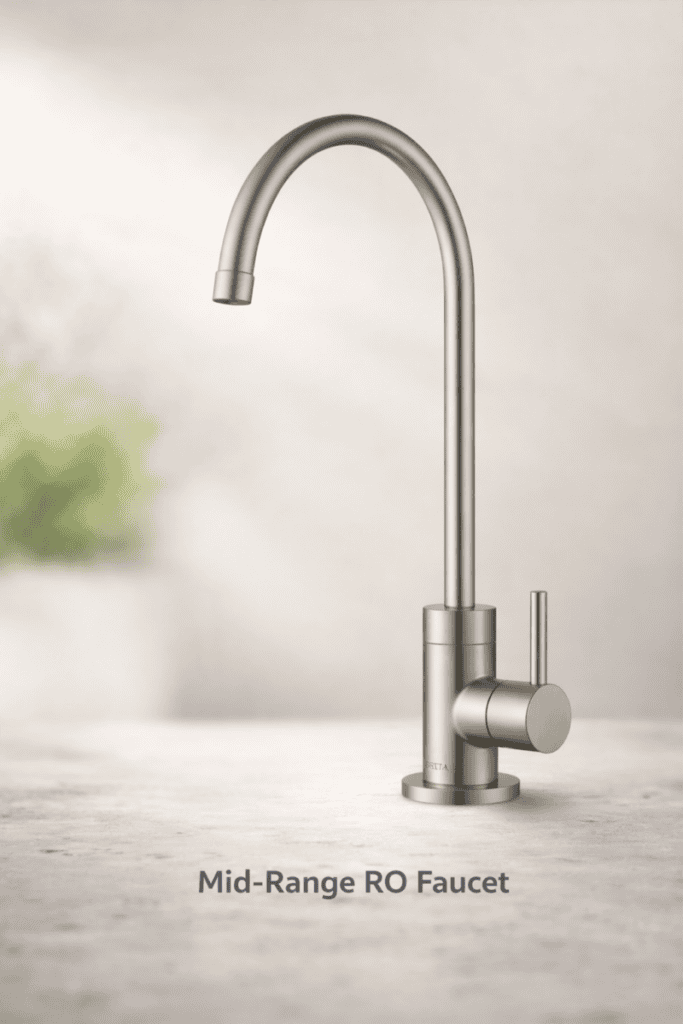
- RO-approved internal components
- Smooth operation + better valve feel
- Easier to find replacement parts
Faucet Option #3 — Premium Brand RO Faucet (Kohler / Delta)
A higher-end RO faucet designed to match premium kitchen fixtures. These are a great option if you want a coordinated look with the main kitchen faucet and prefer strong manufacturer support and available replacement parts.
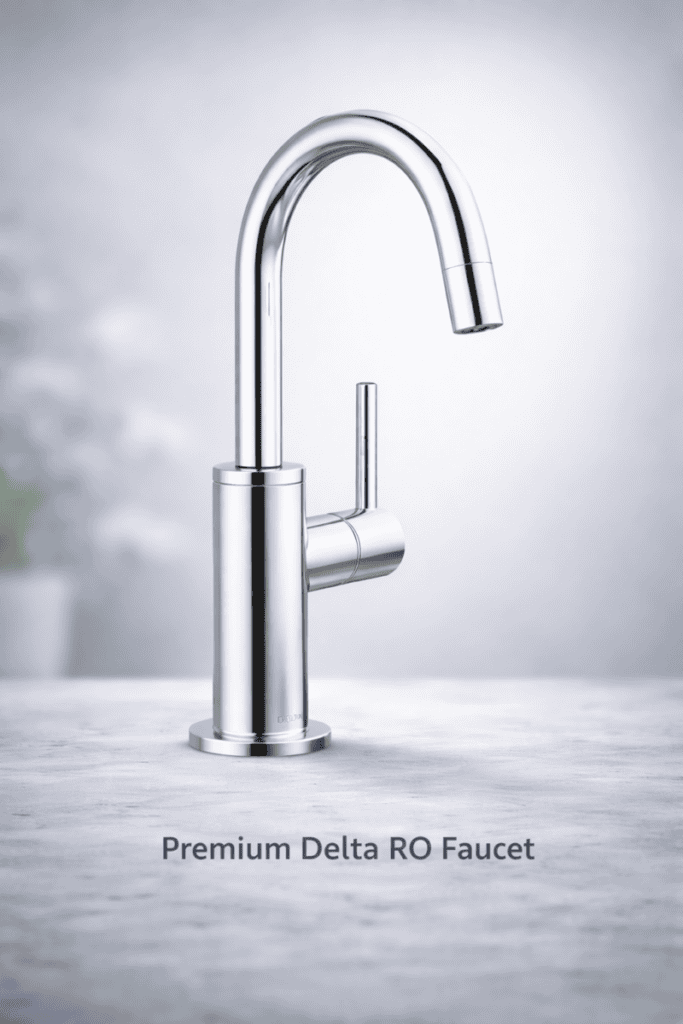
- Excellent warranty & parts availability
- RO-approved and verified in spec sheet
- Ideal for long-term installations
Material Quality Matters More Than Price or Brand Name
When choosing a reverse osmosis faucet, the most important factor is not the price point — it is the material quality, certification, and documented approval for drinking water.
Higher-end brands such as Kohler and Delta offer excellent build quality, durable finishes, and comprehensive certification documentation. These are great options for homeowners who want a premium reverse osmosis faucet that is designed to last and can be verified through spec sheets and manufacturer support.
At the same time, there are also basic, budget-friendly reverse osmosis faucets that perform well when they are properly certified and labeled for drinking water use. A faucet does not need to be expensive to be safe — but it does need to use the correct materials and be approved for reverse osmosis water.
In practice, the spec sheet tells the real story, and that is typically what I review first when helping customers select a faucet.
When a Dedicated Reverse Osmosis Faucet Makes the Most Sense
A dedicated reverse osmosis faucet is especially practical when reverse osmosis water is used frequently for drinking or cooking, when homeowners want the highest confidence in material safety, or when they prefer to keep purified water separate from standard tap water.
A separate faucet also makes it easier to troubleshoot water taste issues, maintain filters, and identify whether taste changes are related to the reverse osmosis system or the main household plumbing.
In most cases, the simplest path to long-term reliability is to use a faucet that is intentionally designed and approved for reverse osmosis drinking water.
Conclusion
A faucet that is safe and approved for reverse osmosis water should be lead-free, NSF certified, constructed from RO-compatible materials, and clearly identified as reverse osmosis approved in the manufacturer’s specification sheet. While some regular kitchen faucets can be used in certain situations, the most reliable long-term option for drinking water is a faucet that is specifically designed and documented for reverse osmosis systems. If you’re also comparing fixture quality and pricing, you may like my guide on cheap kitchen faucets on Amazon — and whether they’re worth buying.
This guide is written from a neutral, professional plumbing-supply perspective with the goal of helping homeowners understand what actually matters when choosing a faucet for reverse osmosis drinking water.